
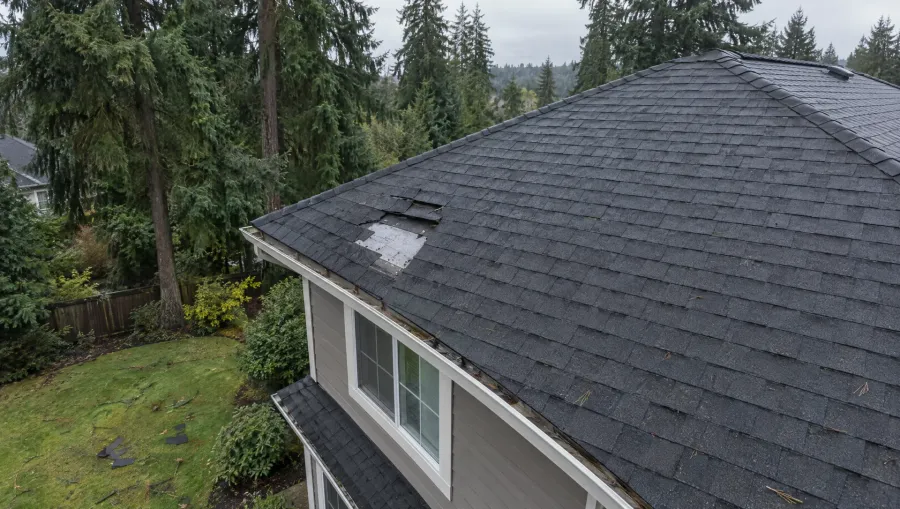
The short answer
Often, yes. If the wind took shingles from one area and the rest of the roof still lies flat and sealed, a roofer can replace just the damaged ones and seal them down by hand. A spot repair stops making sense when the shingles around the gap are too brittle to lift without cracking, when a matching shingle is no longer made, or when the underlayment or decking under the gap is torn or soaked. In 2026 a small repair like this in King and Snohomish counties typically costs $300 to $900. That's a typical range, not a quote.
The morning after a windstorm, the first clue is often a few pieces of shingle on the lawn or the driveway. A handful of missing shingles is rarely a reason for a new roof. Owens Corning, one of the big shingle manufacturers, describes replacing a couple of shingles in an isolated area with minor wind damage as “relatively simple and inexpensive.” Whether that holds for your roof depends on what the repair actually involves, and on the shingles that are still up there.
What replacing “just a few” shingles involves
A shingle isn’t held down only by its own nails. Each one is held by two rows of nails: its own, and the row from the course above, which goes through its top edge. IKO, another shingle manufacturer, lays out the steps in its repair guide. To free one damaged shingle, the roofer breaks the factory seal on it and on the shingles above it, up to two courses higher, lifts them, and pulls the nails. The new shingle goes in, the shingles above get nailed back, and everything that was lifted gets sealed down again by hand with roofing cement, since the factory sealant needs sun warmth to bond on its own.
So a three-shingle repair also handles the shingles around the gap. If they can bend up and lie back down without damage, the repair blends in and holds against the wind. If they can’t, the job gets bigger.
When replacing a few shingles works
A spot repair is the right call when:
- The damage is in one area, and the shingles elsewhere still lie flat and keep their granules.
- The shingles around the gap are flexible enough to lift without cracking.
- The underlayment under the missing shingles is intact, and the decking feels solid.
- A shingle in the same size and style is still made, in a color close to yours.
On a roof like that, we replace the missing or torn shingles, check the decking under the damaged area for wet or soft wood, and look at the flashing and vents nearby. It’s priced like any small roof repair, typically $300 to $900 in 2026.
When it doesn’t, and what happens instead
The shingles around the gap are old and brittle. Asphalt shingles dry out as they age and get stiffer in the cold. According to the Insurance Institute for Business & Home Safety (IBHS), after 7 to 10 years the sealant weakens enough to significantly reduce a shingle’s ability to resist wind. An older roof with dried-out, cracked, or curled shingles is at greater risk of being badly damaged by wind.
Our winters don’t help. Owens Corning’s installation instructions call for extra care handling shingles below 40 degrees Fahrenheit and warn that shingles can be broken easily in cold weather, and in NOAA’s 1991 to 2020 normals for Paine Field in Everett, the average daily high stays under 50 degrees from November through February. A brittle shingle lifted on a cold morning can crack, and then it needs replacing too. IBHS suggests working with a roofing contractor “to make sure one repair doesn’t cascade into other repairs.” When the shingles around the gap won’t survive being lifted, the honest options are a larger repair or re-covering that section of the roof.
Your shingle is no longer made. Manufacturers retire product lines and colors. In January 2025, for example, Owens Corning announced it was discontinuing its Berkshire shingles in all five colors. IKO’s guide also points out that the replacement has to be the same size as the old shingle. When the exact shingle is gone, the choice is between the closest current color, which will show, and re-covering the whole affected slope so the new color doesn’t sit as a patch in the middle of the old one. Even a good match looks a little different at first, because the new shingles haven’t been through the weather yet. That difference fades with time.
The damage goes below the shingles. Under the shingles sits the underlayment, a secondary layer that protects the roof from water that gets past the shingles. When wind strips the shingles and that layer takes days of rain, or a branch tears through it, the repair has to include the underlayment and a look at the wood decking beneath it. Soft decking gets replaced, and the price climbs: damage across a whole slope, or deep enough to soak the decking, can reach $1,500 to $2,500 or more. Like the $300 to $900 for a small repair, that’s a typical range, not a quote.
The damage is all over the roof. Missing shingles on several slopes, or a roof that’s already near the end of its life, is a different conversation. Our guide to roof repair or replacement walks through how we make that call, and if the storm damaged the whole roof, start with storm damage and insurance.
What to look for after a windstorm
Most wind damage can be spotted without a ladder. Look from an upstairs window, or use binoculars from the ground. Walk around the house and look for:
- Pieces of shingle in the yard, on the driveway, or in the gutters
- Patches where the roof changes color, which usually means shingles are gone and the underlayment shows
- Missing caps along the ridge and the hips
- Shingle edges that look slightly raised, a sign the seal may have broken
- A thin, straight line across a shingle near its edge, which can mean it flipped up in the wind and creased
- Bent or loose flashing at the chimney, and damaged roof vents
- Branches lying on the roof
Then check inside. In daylight, and only if you can do it safely, take a flashlight into the attic and look for wet spots on the underside of the roof or daylight coming through. Check the ceilings upstairs for new stains. Some wind damage is hard to see from below, especially a broken seal under a shingle that still looks flat, so a close inspection is worth it even when only a few pieces came down.
What to do while you wait
Stay off the roof and off the ladder. Wet shingles are slippery, and a gust can knock you off balance.
If water is coming in, set a bucket or towels under the drip and move furniture and electronics out of the way. If it’s running near a light fixture or the ceiling is sagging, keep everyone out of that room and switch off its circuit at the breaker if you can reach the panel safely. Our emergency roof repair page explains how we stop the water first and make the permanent repair after.
Take photos of the damage from the ground and inside before anything gets cleaned up. If you might file a claim, Washington’s Office of the Insurance Commissioner advises calling your insurer or agent as soon as possible, documenting the damage, and saving receipts for temporary repairs. A small repair often costs less than the deductible, though, so the claim may not be worth filing.
Two small things help with the match. Keep one of the pieces that blew off instead of throwing it out, since it shows the style and color of your shingles. And if the last roofer left a bundle in the garage or the attic, tell us. Leftovers from the original job may be close in color, though not always an exact match after the roof’s years in the weather. The wrapper also lists the shingle’s wind rating.
How we handle a few blown-off shingles
A wind-damaged shingle repair with us starts with a free inspection. We look at the damaged area and at the shingles around it, photograph what we find, and tell you whether a spot repair will hold or why it won’t. The price comes in writing before any work starts. We do this across King and Snohomish counties, from Everett and Snohomish down to Bellevue, Redmond, and Renton. If you lost shingles in the last storm, request a free inspection.
Frequently Asked Questions
Can you repair just part of a roof?
Yes, when the damage is confined to one area and the rest of the roof is sound. A few missing or torn shingles can be replaced on their own. Damage that covers one side of the roof can sometimes be handled by re-covering just that slope, though the new shingles may stand out next to weathered ones. When the damage is spread across several slopes or the roof is near the end of its life, replacing the whole roof usually makes more sense, and we'll show you photos either way.
How many missing shingles can be fixed without a new roof?
There's no set number. A handful of shingles from one spot is a routine repair. What decides it is the condition of the shingles around the damage, whether a matching shingle is still made, and whether water has reached the underlayment or the decking. We check all three during the free inspection and show you what we find.
Why did the wind take only a few shingles?
Wind doesn't pull evenly on a roof. According to Owens Corning, uplift pressure is highest at the corners of the roofline and almost as high along the edges, so shingles there tend to go first. Beyond that, the weak spots are usually shingles whose seal has already failed with age, or installation problems such as nails in the wrong place or a missing starter strip at the edge. Knowing which one it was tells you a lot about whether the rest of the roof is likely to follow.
What if my shingle color has been discontinued?
Then the repair uses the closest color still made, and it will show to some degree. Manufacturers do retire product lines and colors, sometimes every color of a line at once. If the patch would sit in the middle of a slope you see from the street, re-covering that whole slope can look better. Check for a leftover bundle from the original job first.
Can I leave a few missing shingles until spring?
We don't recommend it. The underlayment under the gap is a backup layer, not a roof surface, and at NOAA's Sand Point station about 73% of the year's rain falls from October through March. IBHS testing found that when wind strips shingles and leaves the deck exposed, each inch of rain can let in the equivalent of nine bathtubs of water. Washington's Insurance Commissioner also warns that insurance won't cover water damage if you delay repairs after a storm damages your roof.
Can I replace a few shingles myself?
We'd advise against it. Replacing one shingle means breaking the seal on the shingles above it, pulling the nails that hold it, including a row from the course above, then nailing everything back and sealing it down by hand, all while working on a sloped roof. IKO, which makes asphalt shingles, recommends that only trained roofing contractors repair shingle roofs. Wet shingles are slippery, and cold ones crack more easily.
Can wind-damaged shingles be repaired in winter?
Yes, roofers work through the winter. The cold changes how the job is done: shingle installation instructions call for extra care handling shingles below 40 degrees Fahrenheit, and new shingles may take longer to seal on their own and may need to be sealed down by hand. If water is coming in before there's a dry day for the permanent repair, the opening gets a temporary cover first.