
Roof Leak Repair
When water comes through a ceiling in Bellevue or anywhere on the Eastside, we find where it's actually getting into the roof, show you photos of it, and repair that spot. Active leaks go to the front of our schedule.
The short answer
A roof leak usually gets in somewhere other than where the stain shows up. Water gets past a failed detail, like a cracked pipe boot, loose flashing at a chimney or wall, or a valley packed with fir needles, then runs along the roof deck or a rafter before it drips through. Rainier Repair Services traces that path back to the source on Bellevue and Eastside homes, photographs it, and gives you a written price before fixing it. When water is coming in, we can usually inspect within a day or two.
Request a Free Quote
Tell us what's going on and we'll be in touch within 24 hours. Rather talk now? Call (425) 568-5162.
The stain on your ceiling shows where the water ended up, not where it got in. Rain that slips past a roof detail lands on the wooden deck underneath and follows the slope, a rafter, or the top of the drywall until it finds a low spot to drip from. That's why a dab of sealant on the shingles right above the stain so often fails: the real opening is a few feet uphill, or around the far side of a chimney. A leak repair that holds starts with finding that opening.
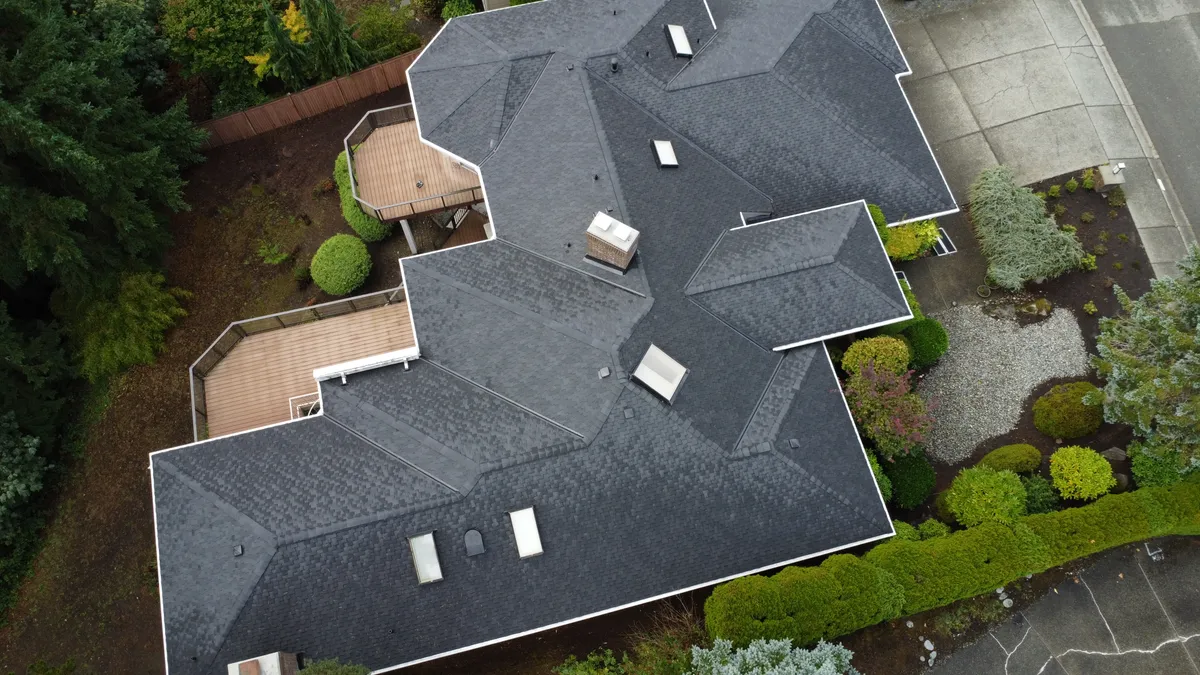
On Eastside homes the same few spots come up again and again. The rubber boots around plumbing vents crack. Flashing pulls loose where the roof meets a chimney, a wall, or a skylight. Valleys, where two slopes meet, fill with fir and cedar needles and hold water against the shingles, and trees cover 39% of Bellevue, according to the city's 2023 canopy assessment. Shingle age matters too: research from the Insurance Institute for Business & Home Safety found that after 7 to 10 years, the sealant that holds shingles down weakens enough to cut their wind resistance significantly, so edges that used to stay flat start to lift.
Some leaks only show up in a hard, windy rain, and that tells you something. A roof in good shape sheds heavy rain. When water gets in only during a storm, wind is usually driving it sideways under a flashing edge or a lifted shingle, or a valley or gutter is overflowing faster than it can drain. November is the wettest month here, averaging 5.85 inches at NOAA's Sand Point station across Lake Washington, and fall rain often comes with wind: during the November 2024 bomb cyclone, the National Weather Service logged a 52 mph gust at a Bellevue station. If your leak only appears in weather like that, tell us which room and which kind of storm. It narrows the search.
A leak call works like any repair visit with us. The inspection is free. We find the source, photograph the failed detail so you can see it for yourself, and put the price in writing before any work starts. If water is coming in and the weather won't wait, we can tarp the area first and come back for the permanent fix. And if the roof turns out to be failing in several places and is near the end of its life, we'll say so, and the photos will show you why.
And not every drip in the attic is a roof leak. If water shows up on cold, clear mornings and never when it rains, you may be looking at condensation forming under the roof deck, often from warm, damp air that a bathroom fan or a blocked vent is sending into the attic. That's a ventilation problem, not a shingle problem, and it's worth ruling out before anyone opens up the roof.
Besides Bellevue, we fix leaks in Kirkland, Redmond, Renton, and Sammamish, and farther north in Everett and Snohomish. Each city page covers the neighborhoods we serve and the roof problems we run into most there.
Frequently Asked Questions
Is it normal for a roof to leak in heavy rain?
No. A roof in decent shape keeps out heavy rain, including the long soaking storms we get from October through March. If water only comes in during hard or windy rain, something specific is letting it in, usually flashing that wind can push water behind, lifted shingles, or a valley or gutter that overflows. Find it before the next storm, because each one wets the decking a little more.
What should I do while I wait for a roofer?
Put a bucket or towels under the drip and move furniture, rugs, and electronics out of the way. Take photos of the stain and anything that got wet, which helps if you end up filing an insurance claim. If water is running near a light fixture or the ceiling is sagging, turn off that room's circuit at the breaker and keep everyone out of the room. Stay off the roof while it's wet. Then call us at (425) 568-5162. Active leaks go to the front of our schedule.
How do you find where a roof leak is coming from?
We work backward from the stain. Where we can get into the attic, the water usually leaves a trail on the underside of the deck or along a rafter, and that trail points uphill toward the opening. Then we check the roof details above it: pipe boots and vents, flashing at walls, chimneys, and skylights, valleys, and any lifted or damaged shingles. When we find the failed spot, we photograph it so you can see it before you approve the repair.
How much does it cost to fix a roof leak?
A leak that comes from one spot, like a cracked pipe boot or a short run of loose flashing, is priced like any small roof repair, which typically runs $300 to $900 in 2026. The price climbs when the water has soaked or softened the decking, when the leak sits on a steep or hard-to-reach part of the roof, or when there is more than one source, and those jobs can reach $1,500 to $2,500 or more. These are typical ranges, not a quote. You get the exact price in writing after a free inspection.
Can you fix a leak without replacing the whole roof?
Usually, yes. A leak from one failed detail on a roof that is otherwise sound gets a targeted repair. Replacement starts to make sense when leaks keep turning up in new places, the decking feels soft across a whole slope, or the shingles are worn out everywhere, not just at the leak. We'll tell you which one you're looking at.
What happens if a roof leak is left alone?
It gets more expensive. Water soaks the insulation, softens the roof decking, and stains and breaks down the drywall below, and damp wood in an attic is where mold gets started. Washington's Insurance Commissioner also warns that insurance won't cover water damage if you delay repairs after a storm or accident damages your roof. And if wind strips shingles off and leaves the deck exposed, IBHS testing found that each inch of rain can let in the equivalent of nine bathtubs of water.
Will homeowners insurance pay for a roof leak?
It depends on the cause. According to Washington's Office of the Insurance Commissioner, homeowner policies usually cover sudden leaks, such as damage from wind, wind-driven rain, or a falling tree, but may not cover leaks that developed slowly. After storm or tree damage, the Commissioner advises covering the leak if it is safe, keeping receipts for tarps and other temporary repairs, and letting the insurer see the damage before permanent repairs. We photograph what we find either way, and we can meet your adjuster on site.
Do I need a permit to repair a roof leak in Bellevue?
Usually not for a typical leak repair. The City of Bellevue's roofing guidance says a residential roof replacement does not need a building permit as long as the decking that gets repaired or replaced stays within five 4-by-8-foot sheets. Replacing more decking than that, or installing or moving a skylight, does need a permit. Code applies either way: if a repair opens an insulated roof cavity, the city requires it to be insulated to full depth before it is closed up.
How can I check that a roofer is licensed in Washington?
Washington requires every construction contractor, roofers included, to register with the Department of Labor & Industries and to be bonded and insured. L&I's free Verify tool shows whether a registration is active, whether the workers' comp account is paid up, and any lawsuits against the contractor's bond. L&I also warns that if uninsured workers get hurt on your roof, you could be liable for their medical bills. Our Washington contractor registration number is RAINIRS800DQ.