
Emergency Roof Repair
When wind tears off shingles or a branch opens up your roof anywhere in King or Snohomish County, we stop the water first, usually with a tarp, then come back for the permanent repair. Active leaks go to the front of our schedule.
The short answer
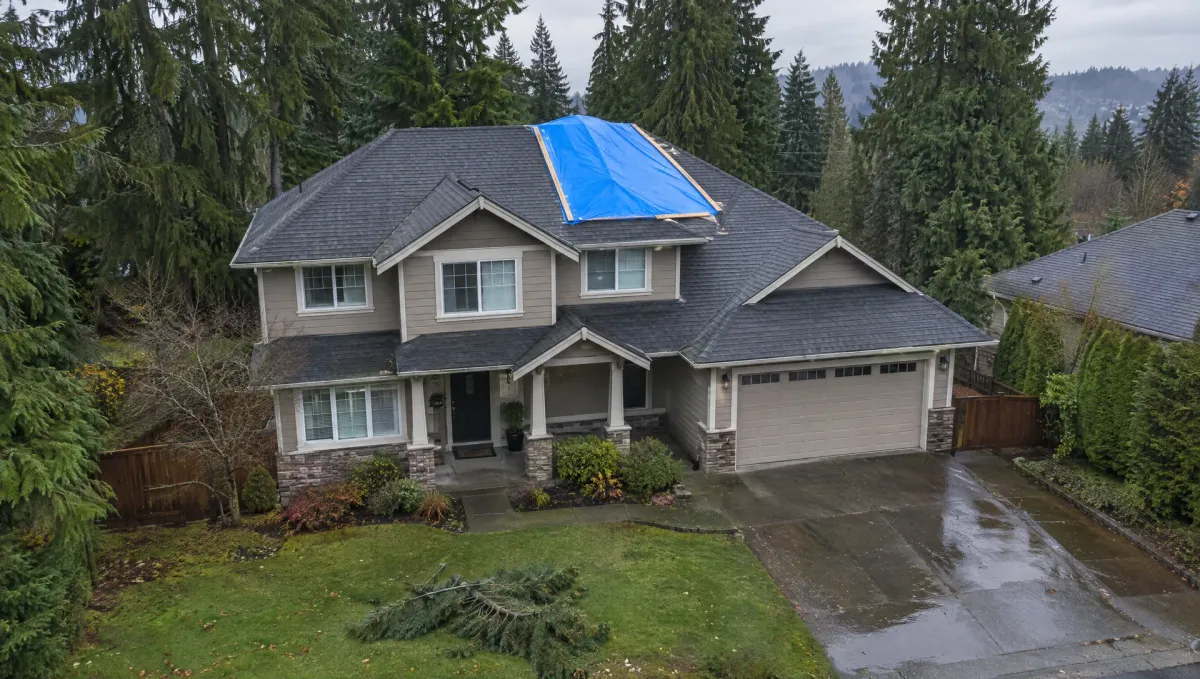
Rainier Repair Services handles small emergency roof repairs across King and Snohomish counties: shingles torn off in a windstorm, a branch through one section of the roof, flashing that let go, or a leak that started in a heavy rain. When water is coming in, we tarp the damaged area first to stop it, then come back for the permanent repair. Active leaks go to the front of our schedule, Monday through Saturday, 7 AM to 6 PM. In 2026 a small repair here typically costs $300 to $900. That's a typical range, not a quote, and you get the exact price in writing after a free inspection.
A roof emergency is often a small problem with bad timing. A gust lifts a row of shingles on the windward side, a fir branch comes down through one corner of the roof, or the flashing at a chimney lets go and water starts dripping into a bedroom. None of that calls for a new roof. It calls for covering the opening so no more water gets in, then a proper repair of that one spot. If the storm damaged the whole roof, our storm damage and insurance page covers full restoration and the claims process.
That's why an emergency repair usually happens in two steps. First, we cover the damaged area with a tarp to stop more water from getting in. Then, when the weather allows, we come back for the permanent repair: we replace the torn or missing shingles, fix the flashing or pipe boot if that's where the water got in, and check the decking under the damage for wet or soft wood before it gets closed up. Before the permanent work starts, you see photos of the damage and get the price in writing.
The two steps also match what Washington's Office of the Insurance Commissioner tells homeowners to do after storm damage. Call your insurer or agent as soon as possible. Take photos or video of the damage. If it's safe, limit further damage. Save every receipt, including the ones for temporary repairs like tarps. And hold off on permanent repairs until your insurer has seen the property and you've agreed on the repairs. A tarp keeps the water out while all of that happens.
Waiting gets expensive. Every rain soaks the decking, insulation, and drywall a little more, and the Commissioner warns that if a storm or accident damages your roof, insurance won't cover the water damage if you delay repairs. The calendar doesn't help, either. In NOAA's 1991 to 2020 normals for Paine Field in Everett, November is the wettest month of the year, with just under 5 inches of rain.
Our crew works Monday through Saturday, 7 AM to 6 PM, and active leaks go to the front of the schedule. When water is coming in, we can usually inspect within a day or two, and sometimes the same day if the schedule allows. If the damage happens at night or on a Sunday, start with the steps below, then call (425) 568-5162 or send a request through our contact form.
An emergency repair is priced like any small roof repair. In 2026 a small repair here, like a few shingles torn off, a cracked pipe boot, or a short run of loose flashing, typically costs $300 to $900. Damage in several spots, across a whole slope, or deep enough to soak the decking can reach $1,500 to $2,500 or more. Those are typical ranges, not a quote.
We take emergency repairs in both counties. In Snohomish County that includes Snohomish and Everett, and in King County, Bellevue, Kirkland, Redmond, Renton, and Sammamish. If water is coming through a ceiling and nothing on the roof looks damaged, start with roof leak repair, where we trace the water back to where it gets in.
What to Do Until We Get There
Start with safety. Stay off the roof, especially while it's wet or the wind is still up. If a tree or branch brought down a power line, keep well away from it and call 911 or your utility before anything else.
Then slow the water down inside. Set a bucket or a stack of towels under the drip, and move furniture, rugs, and electronics out of its path. If water is running near a light fixture or the ceiling has started to sag, keep everyone out of that room, and if you can reach the electrical panel safely, switch off that room's circuit.
Next, document it. Take photos or video of the damage, inside and from the ground outside, before anything gets cleaned up, and keep the receipt for anything you buy or pay for to limit the damage. Then call your insurer or agent.
When we get there, we cover the opening, photograph what we find, and walk you through what the permanent repair involves before any of it starts.
Frequently Asked Questions
What counts as an emergency roof repair?
Any roof damage that is letting water in, or will the next time it rains. Usually that means shingles torn off by wind, a branch that punched through one section, flashing that pulled loose at a chimney or wall, or a leak that showed up in a heavy rain. When the damage is limited to one area, it's a small repair that can't wait. When it covers the whole roof, it's a storm restoration job, and we'll tell you which one you have.
How quickly can you come out when water is coming in?
Active leaks go to the front of our schedule. When water is coming in, we can usually inspect within a day or two, and sometimes the same day if the schedule allows. The first job is stopping the water, usually with a tarp. The permanent repair comes after.
What are your hours for emergency repairs?
Monday through Saturday, 7 AM to 6 PM, the same as for any other job, with active leaks first in line. If the damage happens at night or on a Sunday, protect the inside of the house first (buckets, towels, belongings moved out of the way), then call (425) 568-5162 or send a request through our contact form.
Should I go up and put a tarp on the roof myself?
We'd rather you didn't. A wet roof is slippery, and a tarp catches the wind while you try to hold it down. Washington's Insurance Commissioner advises limiting further damage only if it's safe to do so. From inside the house, that means buckets, towels, and moving your belongings out of the way. Leave the roof to a crew.
Is a tarp a permanent fix?
No. A tarp is a temporary cover that keeps water out until the permanent repair, when we replace the damaged shingles or flashing and check the decking underneath. If you're filing a claim, keep the receipt for the tarp. Washington's Insurance Commissioner advises saving receipts for temporary repairs.
What does a small emergency roof repair usually cost?
About the same as any small roof repair, which in 2026 typically runs $300 to $900 here. The price climbs when the damage is in several spots, runs across a whole slope, or has soaked the decking, and those jobs can reach $1,500 to $2,500 or more. Those are typical ranges, not a quote. You get the exact price for the permanent repair in writing, with photos, after a free inspection.
Will homeowners insurance pay for an emergency roof repair?
Usually, if a sudden event like a windstorm or a falling tree caused the damage. Wear and age are not covered. Washington's Insurance Commissioner advises calling your insurer quickly, documenting the damage, and not making permanent repairs until the insurer has seen the property. A small repair often costs less than your deductible, so a claim may not be worth filing. We photograph the damage either way and can meet your adjuster on site.